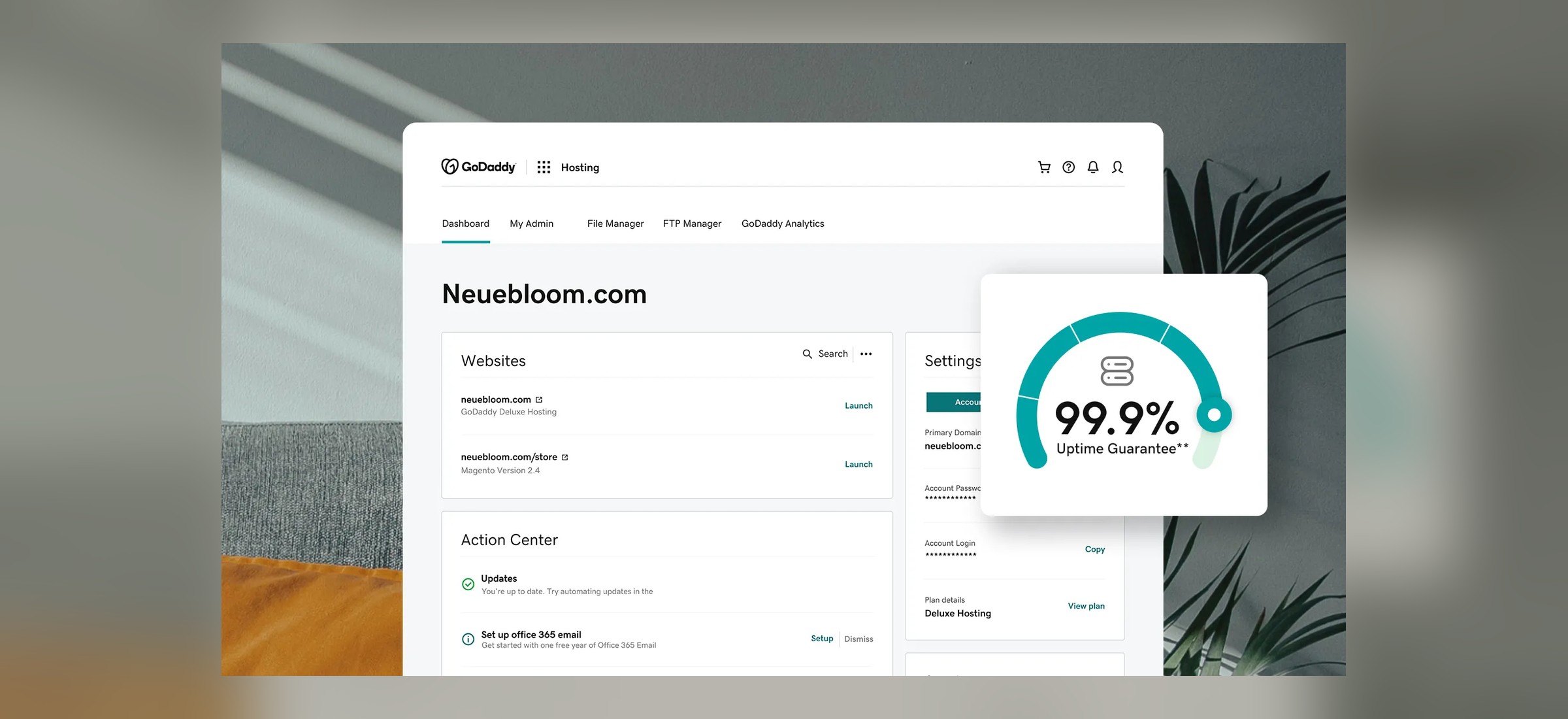
![GoDaddy's own published brand graphic from its Indian site, used here to illustrate a page about GoDaddy's Universal Terms of Service]()
Almost nobody reads the agreement under the shopping cart. GoDaddy's is called the Universal Terms of Service, and it is the document every other GoDaddy contract — hosting, domains, email, the builder — is stacked on top of. We read the version published on its Indian site on 13 October 2026, stamped "Last Revised: 03-06-2026".
The first section is the one worth your time. It defines who the agreement is with, and the answer is "any business customer" — a term the document then stretches to cover freelancers, influencers, content creators, job seekers and anyone registering a domain to protect their own name. It finishes: "Our Services are not intended for private, personal or household use."
Below: that definition in full, the liability cap written in US dollars, the clause that makes changes effective the moment they are posted, and what the agreement says can happen to your files. Everything is quoted verbatim from GoDaddy's own page. This is a description of a published document, not legal advice.
Verbatim, from GoDaddy's Universal Terms of Service
Read 13 October 2026 on godaddy.com/en-in/legal/agreements/universal-terms-of-service-agreement
"Our Services are not intended for private, personal or household use. This business customer limitation applies notwithstanding anything to the contrary in any product description, agreement, or policy, and prevails over any conflicting or inconsistent terms."
📅 Update log:
13 October 2026 — First publication. GoDaddy's Universal Terms of Service read in full from godaddy.com/en-in/legal/agreements/universal-terms-of-service-agreement, logged out, in India, nothing bought and no account opened. Document stamped "Last Revised: 03-06-2026"; approximately 127,000 characters of text and 600 sentences over 45 characters. Captured and quoted: the section 1 definition of "you" and of "business customer" including all four limbs and the named examples, the not-for-personal-use sentence and the priority clause attached to it; the modification clause and its email-notice carve-out; the capitalised reservation of the right to change prices and fees; the section 4 account provisions; the deny/cancel/terminate/suspend clause and the fraud-signal account-closure clause; the data-destruction-on-termination clause; the user content licence and the "GoDaddy Data" carve-out; the prohibited-content removal clause; the product credit one-year expiry; the end-of-life 30-day notice undertaking; the refund cross-reference to the separate Refund Policy; the section 16 per-country payment entity list including the Indian entity; the capitalised $10,000 aggregate liability cap; the indemnity clause and its survival provision; and the section 25 dispute-resolution provisions including the Federal Arbitration Act reference and the capitalised arbitration warning. No price, plan cost or coupon code is asserted anywhere on this page. Content verified 13 October 2026.
The sentence worth knowing before you buy
GoDaddy's Universal Terms of Service is the agreement sitting underneath every other GoDaddy contract — hosting, domains, email, the website builder. We read the version published on its Indian site on 13 October 2026. It is stamped "Last Revised: 03-06-2026" and runs to roughly 127,000 characters.
Section 1 does something most shopping-cart terms do not. It defines who the agreement is for, and the definition has one job: "The terms ‘you’, ‘your’, ‘User’ or ‘customer’ shall refer to any business customer who accepts this Agreement, has access to your account or uses this Site or the Services."
Then it defines "business customer" so broadly that it is hard to buy a domain and fall outside it — and finishes with a sentence that leaves no room for doubt: "Our Services are not intended for private, personal or household use."
Verbatim, from GoDaddy's Universal Terms of Service, read 13 October 2026: "Our Services are not intended for private, personal or household use. This business customer limitation applies notwithstanding anything to the contrary in any product description, agreement, or policy, and prevails over any conflicting or inconsistent terms."
Who counts as a "business customer", in GoDaddy's own words
| Category | The agreement's wording | What it reaches |
|---|
| Any commercial entity | "any commercial entity, partnership, company, organization, sole proprietor, self-employed individual, or independent contractor" | The uncontroversial core of the definition |
| Anyone acting professionally | "any person or entity acting in a business or professional capacity" | Wide, and not limited to registered businesses |
| Personal branding and job hunting | "any individual using Services for professional purposes (including, for example, personal branding, online presence, reputation management, career advancement, or professional networking)" | A personal site built to help you get hired is inside this |
| Protecting your own name | "any individual acquiring Services to protect, secure, or manage their personal name, identity, brand, or online reputation for a business or professional purpose" | Registering yourname.com defensively is named explicitly |
| The named examples | "freelancers, consultants, influencers, content creators, job seekers, and defensive domain registrations" | GoDaddy's own list, not our paraphrase |
| What is left out | "Our Services are not intended for private, personal or household use." | The sentence that completes the definition |
| And it overrides the rest | "This business customer limitation applies notwithstanding anything to the contrary in any product description, agreement, or policy, and prevails over any conflicting or inconsistent terms." | A priority clause: this definition beats the others |
Read that list again and notice who is on it. Job seekers. Content creators. Influencers. Someone registering their own name as a domain so that nobody else does. None of those people would ordinarily describe themselves as a business buying a business service, and the agreement names all of them.
We are reporting what the document says, and stopping there. Whether a definition in a contract actually determines a person's legal status, or affects any statutory protection they have, is a question for a court or a regulator and not for a shopping guide. Nothing on this page is legal advice, and nothing here tells you what your own position is. What we can say is that the sentence is published, it is current, and most people clicking through checkout will never have read it.
The liability cap is written in US dollars
The limitation-of-liability section ends with a figure, in capitals: "IN ADDITION, YOU SPECIFICALLY ACKNOWLEDGE AND AGREE THAT IN NO EVENT SHALL GoDaddy'S TOTAL AGGREGATE LIABILITY EXCEED $ 10,000.00 U.S. DOLLARS."
That is notable on an Indian page for a simple reason: the same agreement prices things in rupees elsewhere, and its payments section says that "if your payment was identified as being processed in India, your transaction will be processed by GoDaddy India Domains and Hosting Services India Pvt Ltd". The money going in is rupees through an Indian entity; the ceiling on what can come back out is denominated in dollars.
The dispute-resolution section is built on American procedure too. It states that "the Federal Arbitration Act (9 U.S.C. §1, et seq.) governs the interpretation and enforcement" of its arbitration subsection, and warns in capitals that "ARBITRATION MEANS THAT YOU WAIVE YOUR RIGHT TO A JUDGE OR JURY IN A COURT PROCEEDING AND YOUR GROUNDS FOR APPEAL ARE LIMITED AS A MATTER OF LAW", adding candidly that "in some instances, the costs of arbitration could equal or even exceed the costs of litigation". The document's own header note says the arbitration requirement applies "IN THE UNITED STATES, TO THE EXTENT PERMITTED BY APPLICABLE LAW".
Changes take effect the moment they are posted
There is no notice period. "GoDaddy may, in its sole and absolute discretion, change or modify this Agreement, and any policies or agreements which are incorporated herein, at any time, and such changes or modifications shall be effective immediately upon posting to this Site" — with the dispute resolution section carved out as the one exception.
Email notification is described as optional and unguaranteed: GoDaddy "may occasionally notify you of changes or modifications to this Agreement by email", and "assumes no liability or responsibility for your failure to receive an email notification so long as it sends the email to the current email address you have listed for your Account".
The practical reading is the one the document itself gives: "Your use of this Site or the Services after such changes or modifications have been made shall constitute your acceptance of this Agreement as last revised." Continuing to use the service is the acceptance. The same section also reserves the right, in capitals, to "MODIFY, CHANGE, OR DISCONTINUE ANY ASPECT OF THIS SITE OR THE SERVICES, INCLUDING WITHOUT LIMITATION PRICES AND FEES FOR THE SAME, AT ANY TIME".
What happens to your files if the account goes
This is the clause most worth knowing if you host anything with GoDaddy. "If GoDaddy terminates your access to this Site or the Services, GoDaddy may, in its sole and absolute discretion, remove and destroy any data and files stored by you on its servers."
The grounds for termination are wide and self-assessed. GoDaddy "reserves the right to deny, cancel, terminate, suspend, or limit future access to this Site or any Services (including but not limited to the right to cancel or transfer any domain name registration)" where a user "otherwise engages or has engaged in inappropriate or unlawful activity while utilizing a GoDaddy site or service (as determined by GoDaddy in its sole and absolute discretion)".
And it extends to accounts that merely look wrong: "If your purchase or Account activity shows signs of fraud, abuse or suspicious activity, GoDaddy may cancel any Services associated with your name, email address or account and close any associated GoDaddy Accounts."
The practical takeaway, and it costs nothing: keep your own backup of anything you host, and keep the email address on your GoDaddy account current. Both follow directly from clauses the agreement publishes — the data-destruction clause above, and GoDaddy's statement that it "assumes no liability" for a notice email you do not receive at the address on file.
The credit clause, and a word in GoDaddy's favour
Promotional credits are the kind of thing terms usually leave vague. This agreement does not: "such Credit is only valid for one year and is only available with a valid purchase and may be terminated in the event the Purchased Product is deleted, cancelled, transferred or not renewed. The Credit will expire one year from date of purchase".
That is a clear rule, published in advance, in plain terms. A page that only listed a company's least generous clauses would be a worse guide than one that says where the document is straight with you. The end-of-life clause is similar: GoDaddy undertakes that "we will attempt to notify you thirty or more days in advance of the EOL date" when a service is being retired.
On refunds, the Universal Terms defers rather than deciding: "Products and Services available for refunds are described in our Refund Policy." That is a separate document, and it is the one that changed on 15 October 2026 — we read both versions of it side by side in a separate piece, linked below.
Other clauses we found worth noting, quoted verbatim
- Indemnity, both directions: "You agree to protect, defend, indemnify and hold harmless GoDaddy… from and against any and all third-party and first-party claims, demands, costs, expenses, losses, liabilities and damages of every kind and nature (including, without limitation, reasonable attorneys' fees)" — and it "shall survive any termination or expiration of this Agreement".
- User content licence: posting content to a GoDaddy-hosted site "authorize[s] GoDaddy to use the intellectual property and other proprietary rights in and to your User Content to enable inclusion and use of the User Content".
- "GoDaddy Data" is carved out of your content: "User Content does not include any ‘GoDaddy Data’… all information relating to GoDaddy's business and delivery of the Services, including but not limited to PII concerning you".
- Prohibited content removal: GoDaddy "may remove any item of User Content (whether posted to a website hosted by GoDaddy or User Content posted to this Site) and/or suspend or terminate a User's access".
- Payment entity by country: transactions are routed to different GoDaddy companies — GoDaddy.com, LLC in the US, GoDaddy Europe, Ltd in the UK, and "GoDaddy India Domains and Hosting Services India Pvt Ltd" for payments identified as processed in India.
- Authentication: GoDaddy "reserves the right (but undertakes no duty) to require additional authentication from you" where there is "reasonable doubt about the authenticity of any such instruction".
What to actually do with this
- Read section 1 before you read the price. It is short, it is at the top, and it is the clause that frames every other document GoDaddy will ask you to accept.
- Keep your own backups. The agreement reserves the right to "remove and destroy any data and files stored by you on its servers" on termination.
- Keep the account email current. Changes are effective on posting, and the only notice you may get goes to the address on file — which GoDaddy accepts no liability for you failing to receive.
- Check the Refund Policy separately. The Universal Terms do not contain the refund windows; they point at another document, which changed on 15 October 2026.
- Use the credit within a year. One year from date of purchase, and it dies with the product it came attached to.
Frequently Asked Questions
What are GoDaddy's Universal Terms of Service?
They are the master agreement underneath every other GoDaddy contract — hosting, domains, email and the website builder each have their own terms, and all of them sit on top of this one. The version published on GoDaddy's Indian site and read on 13 October 2026 is stamped "Last Revised: 03-06-2026" and runs to roughly 127,000 characters. It covers who the agreement is with, account rules, fees and payment, user content, limitation of liability, indemnity and dispute resolution. Refund windows are not in it; it points to a separate Refund Policy.
Does GoDaddy treat personal customers as business customers?
Its Universal Terms define the customer that way in terms. The agreement says "you" means "any business customer", and then defines that to include "any individual using Services for professional purposes (including, for example, personal branding, online presence, reputation management, career advancement, or professional networking)" and, by name, "freelancers, consultants, influencers, content creators, job seekers, and defensive domain registrations". It then states: "Our Services are not intended for private, personal or household use." That is a description of published wording. Whether such a definition affects anyone's legal status or statutory protections is a matter for a court or regulator, not for this page, and nothing here is legal advice.
How much is GoDaddy's liability capped at?
The agreement states, in capitals: "IN NO EVENT SHALL GoDaddy'S TOTAL AGGREGATE LIABILITY EXCEED $ 10,000.00 U.S. DOLLARS." The figure is denominated in US dollars on a page that prices services in rupees and whose own payments section says Indian transactions are processed by "GoDaddy India Domains and Hosting Services India Pvt Ltd". We are reporting the clause as published. We do not assess whether it is valid or enforceable, and statutory rights apply to a transaction regardless of what a contract document says.
Can GoDaddy change its terms without telling me?
On its own wording, the changes take effect whether you are told or not. "GoDaddy may, in its sole and absolute discretion, change or modify this Agreement… at any time, and such changes or modifications shall be effective immediately upon posting to this Site." Email notice is optional — GoDaddy "may occasionally notify you… by email" and "assumes no liability or responsibility for your failure to receive an email notification" sent to the address on your account. The agreement treats continued use as acceptance. The same section reserves the right to change "PRICES AND FEES… AT ANY TIME".
What happens to my website files if GoDaddy closes my account?
The agreement is explicit: "If GoDaddy terminates your access to this Site or the Services, GoDaddy may, in its sole and absolute discretion, remove and destroy any data and files stored by you on its servers." The grounds are broad and self-assessed — GoDaddy may act where a user has engaged in "inappropriate or unlawful activity… (as determined by GoDaddy in its sole and absolute discretion)", and may close accounts where activity "shows signs of fraud, abuse or suspicious activity". The cheap precaution that follows from this is to keep your own backup of anything you host anywhere.
Prices & codes last verified: October 13, 2026
Zoutons may earn a commission when you buy through links on this page. Every quotation on this page is GoDaddy's own published text, read on 13 October 2026 from godaddy.com/en-in/legal/agreements/universal-terms-of-service-agreement, logged out, in India, with nothing bought, no account opened, no service cancelled and GoDaddy not contacted. Quotations are reproduced verbatim, including the source's own capitalisation, spacing and punctuation; any emphasis is ours. This page describes what one published document says. It is a summary for general information, it is not legal, tax or financial advice, and it must not be relied on as a statement of your contractual or statutory rights. Nothing on this page assesses whether any clause described is valid, binding, fair or enforceable, and nothing here tells any reader what their own legal status is — in particular, the fact that a contract defines a customer as a "business customer" is reported as published wording and is expressly not a statement that any reader is or is not a consumer, or that any protection is or is not available to them. Whether a contractual definition or limitation has legal effect is a matter for a court or a regulator. Statutory consumer rights apply to a transaction regardless of what any contract document says, and nothing on this page limits them or purports to. Nothing on this page alleges or implies any wrongdoing, unfair contract term, dark pattern, non-compliance or breach of law by GoDaddy.com, LLC, GoDaddy India Domains and Hosting Services India Pvt Ltd, or any GoDaddy affiliate. A business is generally free to set the terms on which it sells and to define the market it sells to, and publishing those terms openly, as GoDaddy does, is an ordinary and proper commercial act. The document was read as text, which flattens its tables, lists and footnotes and may omit structure; it incorporates numerous other agreements and policies by reference that are not reproduced here, including the Refund Policy, the Privacy Policy, the Anti-Spam Policy and every product-specific Services Agreement, and any of those may qualify or override what is described here for a particular product. We have not tested any clause, made any claim, requested any refund, raised any dispute or had any account terminated, and we make no representation about how GoDaddy would act in any particular case. No price, plan cost, renewal rate, fee or coupon code is asserted anywhere on this page. Legal agreements, their revision stamps and their contents change without notice and may already differ from what is described here; the version published on godaddy.com at the time you read it prevails over anything on this page, and you should read the version that applies to your own account, and take your own advice, before acting.













 Booking com
  Hostinger
  Dell
Dell  Udemy
Udemy  Agoda
Agoda  Nykaa
Nykaa  Myntra
  Ajio
Ajio