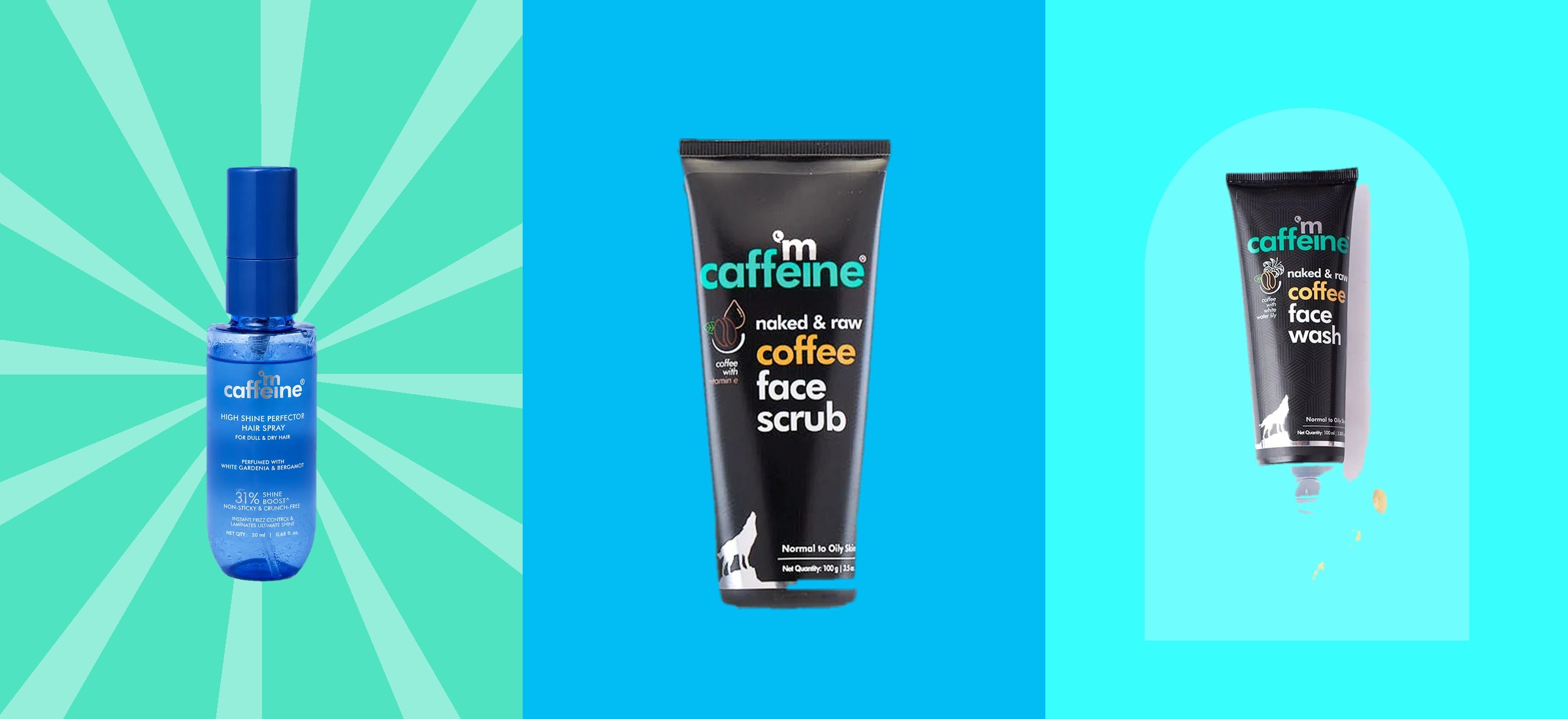
![Three mCaffeine skincare and haircare products of the kind this privacy policy covers, shown as they appear in the brand's own product photographs]()
mCaffeine's privacy policy contains a sentence most shoppers will never see and all of them are bound by: "We and our affiliates will share / sell some or all of your personal information with another business entity should we (or our assets) plan to undergo any merger or acquisition activity." Not "may" — "will". Not only "share" — "share / sell".
We read the page first-party on 7 October 2026, logged out, with nothing purchased. Below: that clause and the protection attached to it, the two sentences on the same page that answer "will you tell me if this changes?" in opposite ways, exactly what the policy says it collects, the opt-in rule that is genuinely better than most, and the Grievance Officer block worth keeping. This describes a published document and assesses no one's compliance with any law; nothing here is legal advice.
Verbatim, from mCaffeine's own privacy policy
Read 7 October 2026 on mcaffeine.com/policies/terms-of-service
"We and our affiliates will share / sell some or all of your personal information with another business entity"
📅 Update log:
7 October 2026 — First publication. mCaffeine's privacy policy read in full from mcaffeine.com/policies/terms-of-service, which serves a privacy policy rather than a terms-of-service document: the share/sell merger clause and the condition attached to it, the two conflicting sentences on notice of changes, the absence of a last-updated date, the browsing-anonymity statement, the payment-data and survey-data collection lists, the message-board and correspondence retention clause, the affiliate-sharing clause and its explicit marketing opt-in, the legal-process disclosure clause, the first-party and third-party cookie statements, the two company addresses appearing on one page, and the Grievance Officer block published under the Information Technology Act, 2000. Terms verified 7 October 2026.
The clause that says your data goes with the company
Most privacy policies have a paragraph about what happens if the company is sold. They usually say the data "may be transferred". mCaffeine's says something more definite, and uses a word most do not:
"We and our affiliates will share / sell some or all of your personal information with another business entity should we (or our assets) plan to undergo any merger or acquisition activity with that business entity, or re-organization, amalgamation, restructuring of business."
Two things are worth noticing in that sentence, and neither is an accusation. The first is "will" rather than "may". The second is "share / sell": the policy contemplates the information being sold as part of a corporate transaction, which is an ordinary feature of how businesses change hands, and says so in plain terms rather than burying it.
The policy does attach a condition: "Should such a transaction occur that other business entity (or the new combined entity) will be required to follow this privacy policy with respect to your personal information." That is a meaningful protection as drafted. It is also worth reading next to the clause higher up the page saying the policy itself can change without notice, because a promise to follow "this privacy policy" is only as fixed as the policy is.
Transferring customer data in a merger or acquisition is normal and lawful, and nothing here suggests otherwise. It is set down because it is the kind of term nobody reads and everybody is bound by.
The page says two different things about being told of changes
Near the top of the document: "Our privacy policy is subject to change at any time without notice. To make sure you are aware of any changes, please review this policy periodically." That puts the duty on the reader to keep checking.
Near the bottom of the same document: "If we decide to change our privacy policy, we will post those changes on this page so that you are always aware of what information we collect, how we use it, and under what circumstances we disclose it." That promises the reader will always be aware.
The two can be reconciled — posting a change on the page is arguably both "without notice" and a way of making it available — but as written they pull in opposite directions, and a reader looking for the answer to "will you tell me if this changes?" gets two of them. We report both sentences verbatim and draw no conclusion about which governs. The practical response is the same either way: if the terms of a purchase matter to you, keep your own dated copy.
There is no "last updated" date anywhere on the page we read, which is the detail that makes the question live. A policy that can change at any time and does not say when it last did gives a reader no way to tell whether what they are reading is what they agreed to.
What the policy says it collects
The collection section is unusually specific, which is to the brand's credit. In its own words:
On browsing: "On usage of our website whether by logging in or simply surfing, we may collect behavioral information." The policy is explicit that anonymity ends at the point of identification: "You can browse the Website anonymously without revealing your identity or any personal information about yourself. Once you give us your personal information, you are not anonymous to us."
On payment details: "If you transact with us, we collect some additional information, such as a billing address, a credit / debit card number and a credit / debit card expiration date and/ or other payment instrument details and tracking information from cheques or money orders."
On surveys: "We will occasionally ask you to complete optional online surveys. These surveys may ask you for contact information and demographic information (like pincode, age, education, or income)." The policy calls these optional and says the data is used to tailor content.
On things you write: "If you choose to post messages on our message boards, chat rooms or other message areas or leave feedback, we will collect that information you provide to us. We retain this information as necessary to resolve disputes, provide customer support and troubleshoot problems as permitted by law." Correspondence you send, and correspondence others send about you, may also be collected into a file.
| Question | What mCaffeine's policy states | Effect |
|---|
| If the company is sold | "will share / sell some or all of your personal information with another business entity" | Data transfers |
| Protection on sale | acquirer "will be required to follow this privacy policy" | Policy follows |
| Changes to the policy | "subject to change at any time without notice" | No notice |
| Changes, elsewhere on the page | "we will post those changes on this page so that you are always aware" | Contradicts the above |
| Last-updated date | none published on the page we read | Not shown |
| Browsing without an account | "You can browse the Website anonymously" | Anonymous |
| After you identify yourself | "you are not anonymous to us" | Linked to you |
| Payment data | "a credit / debit card number and a credit / debit card expiration date" | Collected on transacting |
| Surveys | may ask "pincode, age, education, or income" | Optional |
| Sharing with affiliates | to detect fraud and "correlate related or multiple accounts" | Within the group |
| Marketing by those affiliates | "may not market to you ... unless you explicitly opt-in" | Opt-in required |
| Legal disclosure | to "subpoenas, court orders, or other legal process" | On legal process |
| Cookies | "You are always free to decline our cookies if your browser permits" | Declinable |
| Third-party cookies | "We do not control the use of cookies by third parties" | Outside its control |
| Grievance Officer | named with a phone number and email, Mon-Fri 9:00-18:00 | Published |
Who else sees it, and when
Three separate sharing routes are described, and they are worth keeping apart because they work differently.
Within the corporate group. "We may share personal information with our other corporate entities and affiliates to help detect and prevent identity theft, fraud and other potentially illegal acts; correlate related or multiple accounts to prevent abuse of our services; and to facilitate joint or co-branded services that you request." Crucially, the policy limits what those affiliates may then do: "Those entities and affiliates may not market to you as a result of such sharing unless you explicitly opt-in." That is a genuine restriction and a better term than many comparable pages carry.
On legal process. Personal information may be disclosed "if required to do so by law or in the good faith belief that such disclosure is reasonably necessary to respond to subpoenas, court orders, or other legal process", and to law enforcement or third-party rights owners where reasonably necessary to enforce the terms, respond to infringement claims or protect safety.
On a corporate transaction. The share/sell clause above.
On third parties generally the policy disclaims control rather than responsibility for choosing them well: it says it takes "effort in selecting and facilitiating access to service providers with high privacy and securitystandards" — the spelling and spacing are the page's own — but that it "cannot take responsiblity for third party service providers" and urges readers to review their policies. On cookies placed by others: "We do not control the use of cookies by third parties."
Two smaller things on the page
The URL does not match the document. The page we read sits at mcaffeine.com/policies/terms-of-service, and it is not a terms-of-service document. It opens as a privacy policy, describes collection, use, sharing and cookies, and closes with a Grievance Officer block. A shopper clicking a "Terms of Service" link lands on a privacy policy. We report the URL and its contents as found; mapping policy pages to URLs is a site-build decision and nothing improper is alleged.
Two company addresses appear on the same page. The body names PEP Technologies at a Powai address; the Grievance Officer block names an Andheri (East) address. Both are reproduced as published and we draw no inference from the difference — companies move, and a page can lag. It is noted only because the Grievance Officer block is the part of the page a reader with an actual complaint will use, and it is the one to go by.
That block is the most useful thing on the document. It is published "In accordance with Information Technology Act 2000 and rules made there under" and carries a named officer, a phone number, an email address and stated hours, Monday to Friday, 9:00 to 18:00.
How to use this page
Four practical points, none of them legal advice. One: browse before you identify yourself. The policy itself says you can use the site anonymously and that anonymity ends when you hand over personal information, so there is no reason to create an account before you intend to buy. Two: the surveys are optional. The policy says so, and they ask for income, education and age — which is more than a shampoo order requires. Three: if you have a complaint, use the Grievance Officer block, which is published precisely so that complaints have a named destination, and is faster than any argument about clauses. Four: save a dated copy if it matters. The policy can change at any time, carries no last-updated date, and the version that governs a dispute is not necessarily the one on the screen today. Everything above is mCaffeine's published text as it stood on 7 October 2026. This page describes a document and does not assess whether it complies with any law; nothing here is legal advice.
Frequently Asked Questions
Prices & codes last verified: October 7, 2026
Zoutons may earn a commission when you buy through links on this page. Every quoted sentence, clause and detail here was read on 7 October 2026 from mcaffeine.com/policies/terms-of-service, logged out, in India, with nothing purchased, no account created, no order placed and no data-access or erasure request made; quotations are reproduced verbatim from mCaffeine's own page, including its own spelling, spacing, capitalisation and punctuation, and any apparent error inside a quotation - including 'necessery', 'facilitiating', 'securitystandards' and 'responsiblity' - is the source page's rather than ours and is reproduced rather than corrected. The page served at that address on that date was a privacy policy and not a terms-of-service document; that is reported as found. A published policy can be amended at any time and the page itself states that it is subject to change without notice, so the text described here may already differ from the version that applies to you - the policy shown on mcaffeine.com prevails over anything on this page. This page describes a published document. It does not assess, and expresses no view on, whether that document or any practice described in it complies with the Digital Personal Data Protection Act, the Information Technology Act, the Information Technology (Reasonable Security Practices and Procedures and Sensitive Personal Data or Information) Rules, the Consumer Protection Act, the Consumer Protection (E-Commerce) Rules or any other law, rule or guideline; whether a policy is adequate or lawful is a question for a regulator or a court and not for a price page, and nothing on this page is legal, privacy, data-protection, contractual or financial advice or a substitute for advice from a qualified lawyer. Reporting that a privacy policy contemplates personal information being shared or sold in a merger or acquisition, that it reserves the right to change without notice, that two sentences on the page describe notice differently, that no last-updated date appears, that two company addresses appear, that a terms-of-service URL serves a privacy policy, or that specified categories of data are collected, is a description of published text; drafting and publishing a privacy policy, transferring customer data as part of a corporate transaction, sharing data with affiliates for fraud prevention, disclosing data on legal process, setting cookies and running optional surveys are ordinary and lawful commercial and operational practices, and no statement here alleges a data breach, a privacy violation, unfair trade practice, a dark pattern, misleading advertising or any wrongdoing by PEP Technologies Private Limited, by mCaffeine, or by any affiliate, officer or employee, and none is implied. The Grievance Officer is referred to because mCaffeine's own page names the role; nothing here comments on any individual. No product is assessed, tested, compared or recommended on this page, and no claim is made about whether any mCaffeine product works, is safe or is suitable for any person. We did not buy, open or use any product, and nothing here is medical, dermatological or health advice. We did not place an order, create an account, complete a survey, open a chat or contact the Grievance Officer, so this page describes published policy rather than how any of it is applied in practice, and a reader's own experience may differ. Product photographs are the brand's own images as published in its product feed and may be styled or retouched; several frames in that feed carry the brand's own printed marketing claims and sale badges and were deliberately excluded from the image on this page. The products shown illustrate the kind of purchase this policy concerns, are not offers, and their prices are not stated here. Prices change without notice; the figures shown at your own checkout prevail over anything here.








 Booking com
  Hostinger
  Dell
Dell  Udemy
Udemy  Agoda
Agoda  Nykaa
Nykaa  Myntra
  Ajio
Ajio