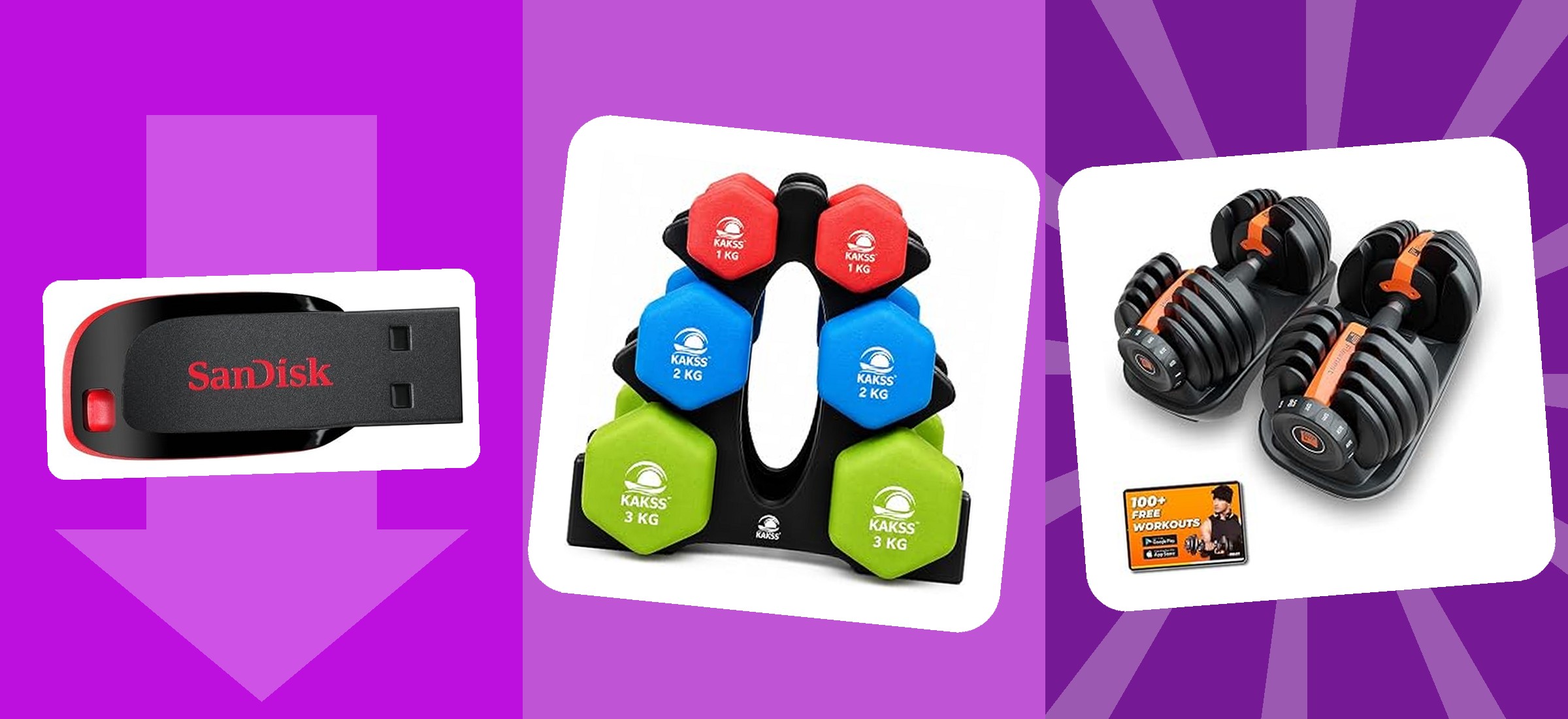
![Three Amazon India listings analysed on this page - a SanDisk Cruzer Blade 64 GB pen drive at Rs. 909, a Kakss 12 kg neoprene dumbbell set at Rs. 2,618 and a Flexnest adjustable iron dumbbell set at Rs. 16,998 - shown as they appear in their own amazon.in listing photographs]()
We scrape Amazon India search results most mornings to price things, and on 29 September 2026 the scrape came back with fifteen listings whose struck-through figure was lower than the price being charged. That cannot be an MRP. So we went back and read the live tiles one at a time.
The smaller number is a per-unit rate - per piece, per gigabyte, per 100 grams - printed in the same kind of price block a struck-through MRP goes in, with the actual M.R.P. sitting separately further down. Below: all eleven listings we could verify, the arithmetic behind each rate, the two we could not make add up, and the three habits that stop you misreading it.
📅 Update log:
29 September 2026 — first published. The 246-listing read and the listing-by-listing verification of the 11 tiles in the table were both carried out on this date, from amazon.in's own search results, logged out, in India, with nothing purchased. Prices, M.R.P.s and unit-rate labels change continuously; the figures here describe those tiles on that day.
A Rs. 909 pen drive with Rs. 14.20 printed beside it
We scrape Amazon India search results most mornings to price things. On 29 September 2026 a routine read of 246 listings threw up 15 rows where the struck-through figure was lower than the selling price - which is impossible for an MRP. A SanDisk 64 GB pen drive at Rs. 909 had Rs. 14 behind it. A dumbbell set at Rs. 275 had Rs. 137.
So we went back to the live search pages and read the tiles one at a time. The smaller figure is not a discount and not an MRP. It is a per-unit rate, printed in its own price block, and the real M.R.P. is a third, higher number further down the tile.
On the SanDisk, the tile reads Rs. 909, then "Rs. 14.20 /count", then M.R.P. Rs. 1,100. Divide Rs. 909 by the 64 gigabytes in the title and you get Rs. 14.20. So on this listing, "count" means gigabytes.
The one-line version: if you see a second, much smaller rupee figure on an Amazon search tile, it is the price per unit - per piece, per gigabyte, per 100 grams - and not the price of the thing. The actual M.R.P. is printed separately and is always higher than the selling price.
Eleven listings, verified one by one
Of the 15 listings that tripped our scraper, 11 were still on the live search results when we went back to check them the same day. Every one of them showed the same three-number pattern: the selling price, a smaller per-unit rate, and a separate M.R.P. above the selling price. Here is the full set, with the true M.R.P. read off the live tile.
| Listing (Amazon India, 29 Sep 2026) | Price | Second figure | Actual M.R.P. |
|---|
| SanDisk Cruzer Blade 64 GB | Rs. 909 | Rs. 14.20 /count | Rs. 1,100 |
| FitBox 5 kg Dumbbells (2.5 kg x 2) | Rs. 275 | Rs. 137.50 /count | Rs. 747 |
| Slovic 10 KG Dumbbells [5 KG x 2] | Rs. 1,599 | Rs. 799.50 /count | Rs. 2,999 |
| ARTINO 3 Kg Pair Hexa PVC | Rs. 303 | Rs. 60.60 /K | Rs. 799 |
| Flexnest Adjustable Iron Set | Rs. 16,998 | Rs. 8,499 /set | Rs. 41,000 |
| Kakss 12 kg set (1+2+3 kg) | Rs. 2,618 | Rs. 872.67 /set | Rs. 5,999 |
| Jimwalt Cast Iron Combo | Rs. 1,819 | Rs. 606.33 /set | Rs. 1,999 |
| Boldfit Adjustable Set | Rs. 16,799 | Rs. 8,399.50 /count | Rs. 19,999 |
| Cockatoo ADB-01 Adjustable | Rs. 16,990 | Rs. 8,495 /count | Rs. 39,998 |
| Cube Club Adjustable 10 Kg | Rs. 3,398 | Rs. 33.98 /100 | Rs. 5,559 |
| Cube Club Iron Dumbbell Set | Rs. 6,599 | Rs. 659.90 /100 | Rs. 10,499 |
The arithmetic works. The labels mostly do not.
The rates themselves are real arithmetic, and you can check every one of them against the listing title:
Per piece. Rs. 275 divided by 2 is Rs. 137.50 - the title says "2.5 kg x 2". Rs. 1,599 divided by 2 is Rs. 799.50 ("5 KG x 2"). The three adjustable sets work the same way: Rs. 16,998 / 2 = Rs. 8,499, Rs. 16,799 / 2 = Rs. 8,399.50, Rs. 16,990 / 2 = Rs. 8,495. These are sold as pairs, so the rate is the price of one dumbbell.
Per pair, in a set of three pairs. The Kakss set contains 1 kg, 2 kg and 3 kg pairs: Rs. 2,618 / 3 = Rs. 872.67. The Jimwalt combo is the same shape: Rs. 1,819 / 3 = Rs. 606.33.
Per gigabyte. Rs. 909 / 64 = Rs. 14.20 on the pen drive - and the label on that one says "/count", the same word used for pieces on the dumbbells.
Per 100 grams. Rs. 3,398 / 100 = Rs. 33.98 on a 10 kg dumbbell, which is a hundred lots of 100 g. The label reads "/100" with no unit at all.
Where it gets genuinely confusing: the word "count" is doing four jobs across these eleven tiles - gigabytes on the pen drive, individual dumbbells on three listings, and pairs on others. "/set" appears on listings where the divisor is 2 and on listings where it is 3. And "/K" and "/100" appear with no unit attached.
Two we could not make add up
We would rather say this than tidy it away. Nine of the eleven rates reconcile exactly with something stated in the listing title. Two do not.
The ARTINO at Rs. 303 shows Rs. 60.60, which means a divisor of 5. Its title says "3 Kg Pair", so the obvious candidates are 3 and 6, and neither gives Rs. 60.60. We do not know what the 5 refers to.
The Cube Club iron set at Rs. 6,599 shows Rs. 659.90, a divisor of 10, while its label reads "/100". If the set weighs 10 kg then Rs. 659.90 is the price per kilo and the label is simply wrong; we could not confirm the weight from the tile.
Neither of these is evidence of anything improper. Unit-rate fields on large marketplaces are generated from seller-supplied pack data, and pack data on a marketplace is frequently incomplete. It is a reason to ignore the number, not a reason to be suspicious of the seller.
Why this is worth two minutes of your attention
Most of the time the per-unit rate is harmless or actively useful - it is how you compare a 500 g pack with a 1 kg one without doing arithmetic in a supermarket aisle. The problem is what happens when the two numbers are far apart.
On the Cube Club 10 kg dumbbell the tile shows "Rs. 33.98" next to "Rs. 3,398". That is a hundredfold difference sitting side by side in similar type, and the smaller number is the one a skimming eye lands on. On the SanDisk it is Rs. 14.20 beside Rs. 909.
The second risk is the one that caught our own scraper: because the per-unit rate occupies the same kind of price block that a struck-through MRP does, it is easy - for software and for people - to read it as the old price. It never is. A struck-through MRP on Amazon is always higher than the selling price, never lower. If the smaller figure has a slash and a word after it, it is a rate.
How we checked this
We read 246 distinct Amazon India listings on 29 September 2026 from amazon.in's own search results, logged out, in India, across searches for mattresses, dumbbells, gas stoves, wifi routers, pen drives and monitors, with ASINs deduped and nothing purchased. 15 of the 246 returned a struck-through figure lower than the selling price. We then re-queried the live search page for each of those 15 by product name the same day; 11 were still returned on the first page of results and were read individually - the selling price, the per-unit price block and its label, and the separate M.R.P. line. The remaining four were not on the first page of results when we went back and are excluded from this page entirely. Every figure in the table above comes from that second, listing-by-listing read. Nothing was bought, and no product on this page is reviewed, recommended or assessed.What to do about it
Nothing dramatic. Three habits cover it.
One: the biggest number on the tile that is not struck through is the price. If a smaller figure has a slash and a word after it - /count, /set, /100, /K, /kg, /ml - it is a rate, and you are not paying it.
Two: if you want to use the rate, check it yourself. Divide the price by the pack size in the title. On nine of the eleven listings here that works exactly; on two it does not, and on one of those the printed label contradicts the arithmetic.
Three: for the discount, find the M.R.P. line. It is a separate figure, written out as "M.R.P.", and it is always above the selling price. That is the number the percentage is calculated from - and, as we have written elsewhere, a stated MRP is a figure the seller chooses rather than a price anything necessarily sold at.
Frequently Asked Questions
Why does an Amazon listing show an MRP lower than the price?
It does not - the smaller figure is not an MRP. On the eleven listings we verified on 29 September 2026, Amazon was printing a per-unit rate in its own price block on the search tile, and the real M.R.P. was a separate, higher figure. A SanDisk 64 GB pen drive at Rs. 909 showed "Rs. 14.20 /count" - Rs. 909 divided by 64 gigabytes - with an M.R.P. of Rs. 1,100 printed further down. A struck-through MRP on Amazon is always higher than the selling price.
What does "/count" mean on an Amazon price?
It depends on the listing, which is the problem. Across the eleven tiles we checked, "/count" meant gigabytes on a pen drive and individual dumbbells on three fitness listings. We also saw "/set" used where the divisor was 2 on some listings and 3 on others, and "/K" and "/100" printed with no unit attached at all. The safest reading is that the label tells you a rate is being shown, and the divisor has to be worked out from the pack size in the title.
Is the per-unit price on Amazon accurate?
The arithmetic usually is; the labelling often is not. Nine of the eleven rates we checked reconciled exactly with a figure stated in the listing title - price divided by pieces, by gigabytes or by 100 g. Two did not: a Rs. 303 dumbbell pair showing Rs. 60.60 implies a divisor of 5, which nothing in its title explains, and a Rs. 6,599 set showing Rs. 659.90 implies a divisor of 10 while its label reads "/100". Unit-rate fields are generated from seller-supplied pack data, so gaps in that data show up here; we allege no wrongdoing by Amazon or by any seller.
Can I trust the discount percentage on an Amazon tile?
The percentage is calculated from the M.R.P. line, not from the per-unit rate, so it is at least internally consistent. What it is worth is a different question: an M.R.P. is a figure the seller states and we have not verified that any product sells at it, so a percentage is arithmetic over two published numbers rather than a measured saving. Stating a high MRP is legal and commonplace across Indian retail. The practical advice is the same one we give on every price page: compare selling prices across listings and shops, not badges.
How common is this?
In our read, 15 of 246 Amazon listings - about one in sixteen - displayed a per-unit rate that our scraper picked up in the MRP position, concentrated on multi-piece fitness equipment and one storage device. That is a count of how often the smaller figure appeared low enough to be obviously not an MRP; tiles where a per-unit rate happens to sit above the selling price would not have been flagged, so the true frequency of per-unit rates on search tiles is higher than one in sixteen. It is a display convention, not a fault, and it appears across categories where products are sold in packs.
Prices & codes last verified: September 29, 2026
Zoutons may earn a commission when you buy through links on this page. Every figure here was read on 29 September 2026 from amazon.in's own search results, logged out, in India, with nothing purchased. The 246-listing count comes from searches for mattresses, dumbbells, gas stoves, wifi routers, pen drives and monitors with ASINs deduped; the eleven listings in the table were each re-queried by product name on the same day and read individually from the live search page. Four further listings that our first read flagged were no longer returned on the first page of results when we went back, and are excluded from this page and from every count in it. Amazon search results are personalised and change continuously, so a different reader running the same query will not see the same tiles, and prices, M.R.P.s and unit-rate labels change without notice. This page describes what a set of search tiles displayed on one date. It is a description and nothing more: it is NOT an allegation, finding, suggestion or implication that Amazon or any seller has mispriced anything, advertised misleadingly, breached the Legal Metrology Act, the Consumer Protection Act or any other law, rule, regulation or platform policy, or acted improperly in any way, and no wrongdoing by Amazon Seller Services Private Limited, by SanDisk, Western Digital, FitBox Sports, Slovic, ARTINO, Flexnest, Kakss, Jimwalt, Boldfit, Cockatoo, The Cube Club or by any other company, brand or seller named or unnamed is alleged or implied. Displaying a per-unit rate is a normal, useful and in many contexts legally required retail practice; where we report that a printed label does not match the arithmetic, we describe a discrepancy between two published figures on one date and note that unit-rate fields on large marketplaces are generated from seller-supplied pack data, which is frequently incomplete. We reached no conclusion about the cause of any discrepancy and made no enquiry of Amazon or of any seller. Our own reading of the divisors - gigabytes, pieces, pairs, 100-gram units - is inference from the pack sizes the listing titles state, not information published by Amazon, and on two listings we could not reconcile the rate with the title at all and say so on the page. An M.R.P. is the figure a listing displays and we have not verified that any product on this page was ever sold at it, so any percentage derived from it is arithmetic over two published numbers rather than a measured saving; stating a high MRP is legal and commonplace across Indian retail. No product mentioned on this page is reviewed, tested, recommended or assessed: we did not buy, unbox, weigh, measure, charge or use anything, and nothing here is a statement about the quality, safety, capacity, weight accuracy or fitness for purpose of any dumbbell, pen drive or other item named. Product photographs are the listings' own images as published on amazon.in. Nothing on this page is legal, financial or consumer-rights advice; readers with a complaint about a specific listing should raise it with the retailer or the appropriate consumer authority. Prices change without notice and can differ at checkout after coupons, bank offers or delivery charges; the price shown at your checkout prevails over anything here.











 Booking com
  Hostinger
  Dell
Dell  Udemy
Udemy  Agoda
Agoda  Nykaa
Nykaa  Myntra
  Ajio
Ajio